There's the same feeling that you get driving slowly past an accident for some
Jericho Sailor's when it comes to following the America's Cup-root beer budget
boaters somewhat reluctantly gawking in awe like stray dogs out in the cold
looking in on a royal banquet at champagne bow sprayed billion dollar
syndicates fuelling highly paid professional crews to match race wind and water
powered rocket ships in pursuit of the oldest active trophy in sport. Even the
proudly frugalest of sailors just can't look away.
English nobleman,
Henry William Paget, the Marquess of Anglesey, first laid down the canvas gauntlet
in 1851 by putting up the "Royal Yacht Squadron Cup" to the winner of the
Annual Regatta around the Isle of Wight. An upstart American syndicate from the
fledgling New York Yacht Club picked it up and soundly slapped the English on
their own waters with a dominating performance by the sailing schooner
"America", victoriously claiming the prize, changing its name to the
"America's Cup " and over the next hundred and twenty six years, contending
from American shores, refusing to give it back- to anyone.
The revolving door syndicates of the "Challenger" and
"Defender " of the Americas Cup have long dueled with serious
resources and ground breaking boat designs and in the end it's always been
about the boat design. For the past century and a half or so, the thirsty quest
to drink from the America's Cup has been broad reaching the evolution of
sailing.
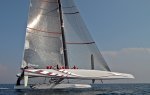
As with accidents, sometimes the America's Cup is a curious
spectacle. Like when its rules have been challenged and decided in court by sea
lawyers or when the sailing craft have diverged so radically in design and performance
only an Aesop's fable could bail out the second place finisher. 2010 could be one
of those years as the wing powered catamaran Swiss "Defender "Alinghi
will be swapping tacks and gybes with the articulating wing trimaran American "Challenger"
Oracle.
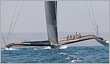
A curious match-up, the venue and dates already had to be
decided in court. From here this will be a Darwinian showdown that will likely
see some ideas evolve and trickle down into the rest of the sailing world and
some into the "has been" evolutionary scrapheap realm of the Dodo
bird. As designs diverge the combined skill of the competing crews often
becomes much less of an issue. The final result might be easily be guessed by
the time the lead boat rounds the first mark.
At its most
competitive best, watching the television coverage of the America's Cup can
rekindle the feeling of sailing, stimulate some excitement for people who hold
the wind and sea close, and the race course in Valencia Spain may even remind
some of summer, which during the cool winter amidst the 2010 Vancouver Olympic
Games could be a welcome break for sailors.
It remains to be seen if the 2010 America's Cup will be as
predictable and uninteresting as the 1988 skirmish that saw a catamaran on
steroids versus the plodding KZ1 a traditional AC monohull (in comparison the
oversize 12metre moving through the water reminded one of a square masted
fully loaded whaling ship) or as exciting as the historic 1983 America's Cup which went down
to the final race where the Australian's became the first syndicate to pry the
Cup from American hands since it was first contested. Either way, even if by accident,
most Jericho Sailor's, the lowest cost dinghy sailing pilots and crews there
are, will want to take a peek.
JSCA Members-Come watch the 2010 America's Cup in High
Definition on the Big Screen of the Sailor's Lounge at the Jericho Sailing
Centre Feb 8; 10; 12 *times TBA, schedule subject to change.
Follow the America's Cup at
www.americascup.com


 Here is what's "in the wind", coming events and items of interest to the 3,500 members of the JSCA and other users of the Jericho Sailing Centre for December/January and beyond.
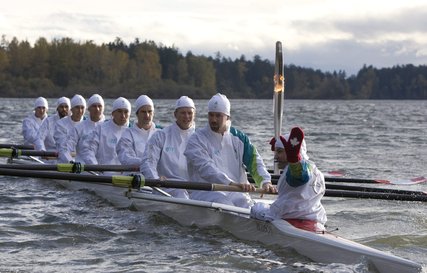 There's a notable event coming to Vancouver in 2010 and the
Jericho Sailing Centre is going to be a part of it. Maybe not a significant
enough part to actually be able to mention the name of the event or display its
symbols without getting a freedom of speech numbing, tongue tweaking from the
organizers, but our organization, along with all Vancouver citizen's, will be proudly
sharing the role of host.
There's a notable event coming to Vancouver in 2010 and the
Jericho Sailing Centre is going to be a part of it. Maybe not a significant
enough part to actually be able to mention the name of the event or display its
symbols without getting a freedom of speech numbing, tongue tweaking from the
organizers, but our organization, along with all Vancouver citizen's, will be proudly
sharing the role of host.